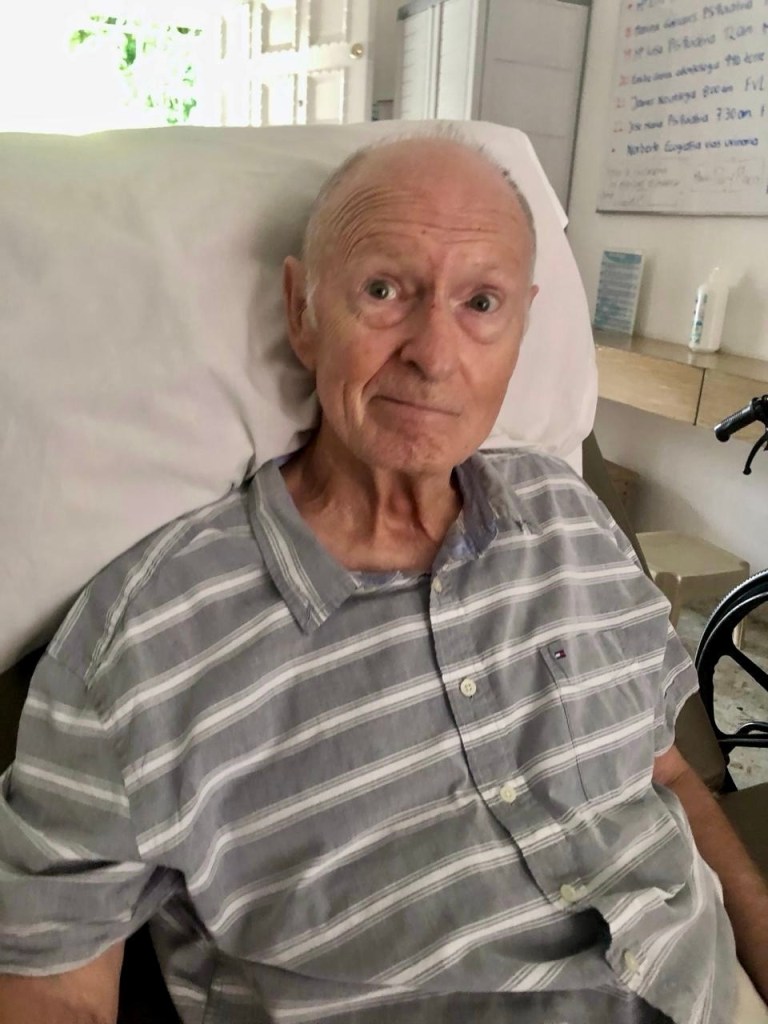
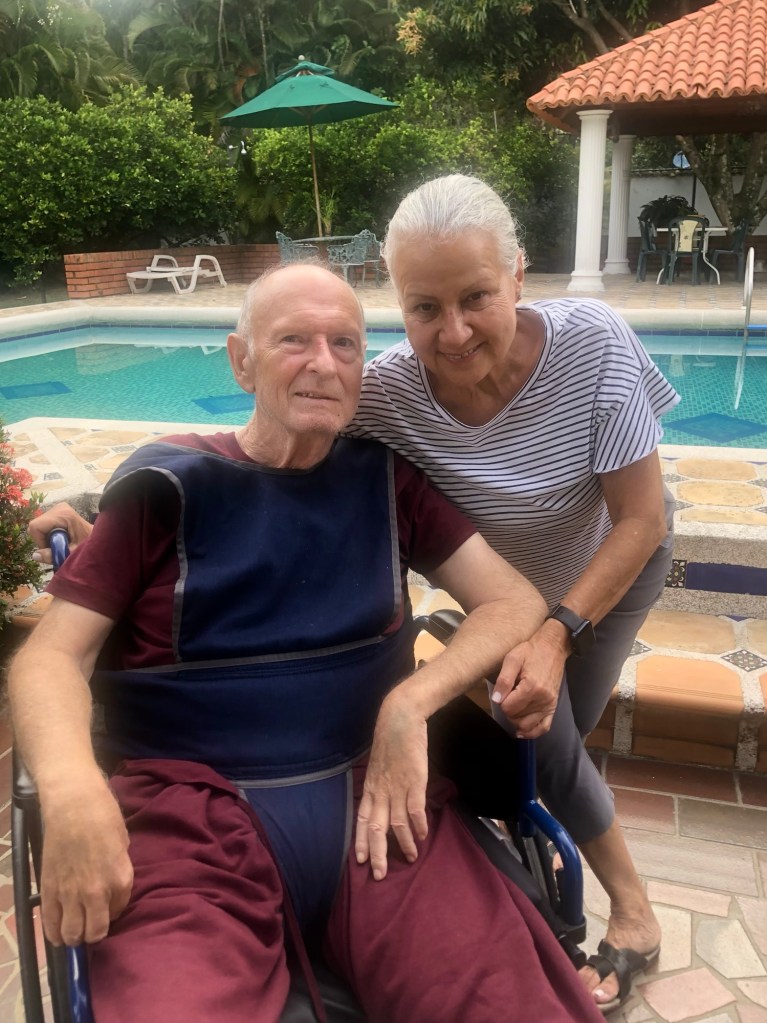
After my last blog entry at the end of June, Kim’s health declined nearly suddenly. One morning in early July when I came in to visit him, he was sitting on his chair in the courtyard, where the nurses typically bring him to. Apparently he had been fine but when I saw him he looked like he had just had a mini stroke — looking to the right, somewhat unresponsive and absent. We called the emergency service I’ve purchased from him and within minutes they arrived. His vital signs were stable and the doctor (yes, a doctor comes on-site) and paramedic who saw him could not figured out what was wrong.
There were three possible reasons: 1) he had had another stroke; 2) the recent changes in medications made by his new psychiatrist and neurologist in Colombia were having adverse effects; or 3) he had an infection of some sort which can make people with TBIs or brain issues act this way. I’ve learned this over the years when Kim has acted like this because he had a cold or illness.
Soon after the emergency doctor and his paramedic left, Kim developed a fever. Since there were a few sick patients with a flu-type illness in his ‘resort hotel’, as Kim continues to refer to his nursing facility, it was determined Kim had come down with the same cold.
After nearly a week of battling the cold, we had to call emergency again since, though the cold was better, he was still very confused and weak, sleeping significantly and nearly all the time. This went on for a few more days eventually landing him in emergency at the nearby hospital where, after a whole night of testing, they found he had a lung infection ( likely some pneumonia) and an UTI. He was put on heavy intravenous antibiotics for 10 days which required a catheter, and an extra trip to the hospital to replace it as he pulled the initial one off one night.
As the antibiotics were taking effect, Kim still looked very tired, often acting very distant and unresponsive, particularly after taking the new medication prescribed by the psychiatrist. I was apprehensive about trying him on it because he’s been put on many different anti-psychotic medications over the years and they actually make him worse. I then put on my ‘researcher’s hat’ and did a thorough research about this med as well as the anti convulsing medication the neurologist had increased. It turned out that neither one of these were good for him – the psychiatric med was not appropriate to help him with the agitation which only occurs occasionally and during transfers. This behavior must be ‘managed’ with appropriate caregiver bag-of-tricks rather than using medication to control it. We then stopped the psychiatric medication.
The neurology medication, which he absolutely needs for preventing the convulsions he started experiencing after the stroke 2 years ago, was lowered to the initial dose because it also made him somnolent, acting like a vegetable and, in addition, at the higher dose, it could cause more AFIBs which were actually detected.
Why am I sharing so many details about this illness and this particular medication fiasco?
Well, because Kim’s illnesses, which have sometimes been caused by more than 1 thing such in this case, my experiences with his medications, and my management of his health has taught me many valuable lessons that I’d like to share.
Over the many years I’ve been managing Kim’s health and navigating medication effects, I’ve learned that one must proactively understand ( research) and provide input (and even recommendations) to doctors on how medications affect us. Also, I’ve learned that illnesses may not just be caused by 1 factor. Our bodies are amazingly complex machines and I’ve found that there’s a tendency to diagnose 1 and only 1 illness, stopping after finding 1 illness. When in reality, there might be confounding effects colluding due to more than 1 factor affecting the body.
In addition, when there are multiple health issues and more than 1 specialist is involved ( e.g., in the case of Kim, the cardiologist, neurologist, psychiatrist, etc), medications can affect the other ailing organs, such as it was the case with Kim, when the increase in the anti-convulsion medication made by the neurologist increased AFIBs in his heart.
As the wonderful doctors Kim’s had at John Hopkins told me, we must always keep in mind that doctors just don’t know how medications really impact each person. Each of us has a unique make up and, for someone with several health issues such Kim, there are many potential interactions.
In addition, ‘partnering’ with doctors has paid off greatly for us. We’ve had the great fortune of having amazing doctors ( e.g., Kim’s doctors at John Hopkins Hospital) who are not just extremely competent but, also, have always sought my assessment about Kim’s reactions to new or changed medications. Fortunately, we’ve found good doctors here in Colombia who did listen to me, though I am not sure they’ve experienced caregivers like me who are very vocal and provide the research-based assessments and recommendations. Put in a positive and cooperative way, doctors have always welcome this.
I encourage anyone reading this blog who is battling a family or his/her own health issue, to proactively get involved, research, partner with your heath team, and ‘manage’ their/your health.


 Cunningham-Ramos AML & Stroke after TBI Journey
Leave a comment