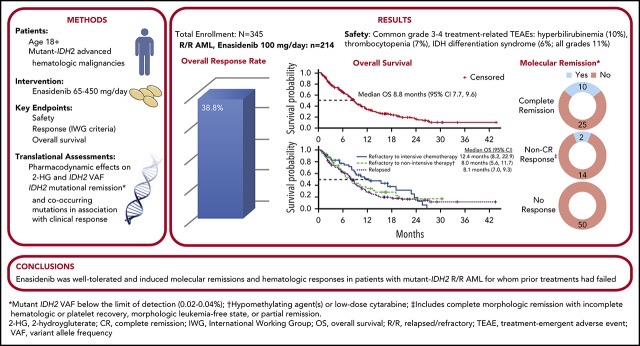
Research results above show that on patients for whom other treatments have not worked, and who have the same mutation (IDH2) that Kim has, the drug Enasidenib results in an overall survival (OS) of 6.5 months. This compares to about an OS of 15 months with the current treatment.
After the end of the 4th treatment, Kim’s decline was so drastic that Maria started doing research and talking to his oncologist, his primary doctors, his therapist, family, and close friends about changing Kim’s treatment. This would be, changing to a less aggressive chemotherapy drug, Enasidenib, which targets the specific cancer mutation Kim has (IDH2), and which does not kill all the other good blood cells in the process. Because of the latter, Kim’s quality of life should be significantly better on Enasidenib as compared to on the current treatment.
However, there were many questions unanswered, mainly what Kim’s overall survival (OS) would be with the new drug versus that of the current treatment and given that the current treatment is working? Would he live cancer free for a shorter period of time? What would his quality of life be like as compared to the current one? There is also a slim chance that the current treatment might wipe out the myeloid cells from his bone marrow.
Maria anguished over this decision which, she tried to explained to Kim to gain his input but which, unfortunately, he could not grasp except to say that he wanted to live to spend the next Christmas or two with his family.
Finally, given all the input and information gained and with Kim’s oncologist’s approval, we decided to undergo one more round of treatments and assess switching in each subsequent treatment.
 Cunningham-Ramos AML & Stroke after TBI Journey
Leave a comment